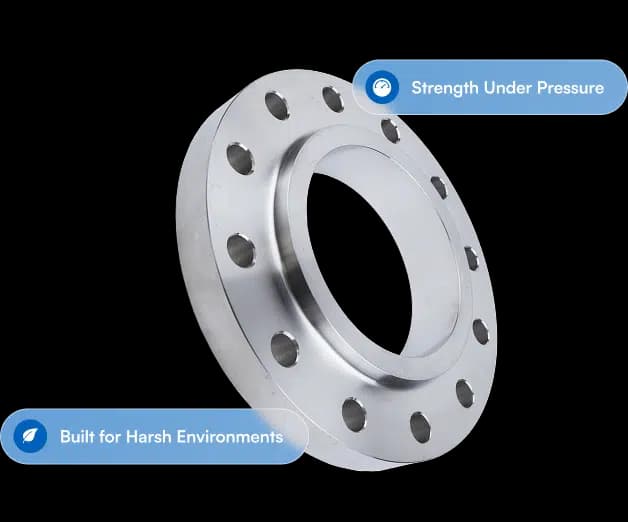
Flange Types
Flange FAQs
Answers to common questions about pipe flanges.
A pipe flange is a disc-shaped fitting with bolt holes around its perimeter, used to create a bolted connection between two sections of pipe or between a pipe and a piece of equipment. Flanges allow piping systems to be assembled, inspected, modified, and maintained without cutting or welding. They are manufactured in standardized sizes and pressure ratings to ensure interchangeability.
The six most common flange types are weld neck (highest strength, butt-welded to pipe), slip on (slides over pipe, fillet welded), blind (solid disc, closes pipe end), socket weld (pipe inserts into socket, fillet welded), threaded (screws onto pipe, no welding), and lap joint (used with stub end, rotates for alignment). Each type has advantages for specific service conditions and installation requirements.
Flange pressure classes (150, 300, 600, 900, 1500, 2500 per ASME B16.5) define the pressure-temperature rating of the flange. A Class 150 flange in Group 1.1 material is rated for 285 psig at 100F, but only 170 psig at 500F. Higher class numbers provide higher pressure capability. The correct class is determined by the design pressure and temperature of the piping system. Contact Flanges.IO for help selecting the right flange for your application.