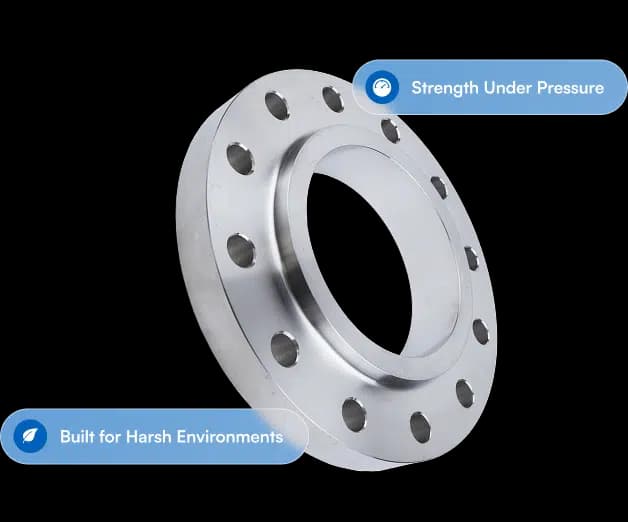
Flange Dimensions / Reference Tools
Flange Wall Thickness
Minimum wall thickness requirements for ASME B16.5 flanges
The minimum wall thickness of a pipe flange is one of the most important dimensional parameters for pressure integrity. ASME B16.5 defines the minimum flange thickness (measured through the hub at the thinnest point) for each pressure class and nominal pipe size combination. This thickness must be maintained after machining of the flange face, gasket seating surface, and any facing operations. The thickness directly determines the flange's ability to resist bending moments, bolt loads, and internal pressure without exceeding allowable stress levels.
Wall thickness increases significantly with pressure class because higher pressure ratings demand greater resistance to hydrostatic end force and higher bolt loads for gasket seating. For a given pipe size, a Class 2500 flange may be four or more times thicker than a Class 150 flange. The table below shows the minimum thickness values for a 6-inch flange across all standard ASME B16.5 pressure classes as a representative example. Actual dimensions for other sizes should be referenced from the complete B16.5 dimension tables.
When specifying flanges, engineers should verify that the delivered flange thickness meets or exceeds the B16.5 minimum after all machining. Flanges that fall below minimum thickness due to over-machining, corrosion allowance reductions, or manufacturing defects must be rejected. For critical service applications, many specifications require positive material identification (PMI) and dimensional verification of wall thickness as part of the quality control program.
| Pressure Class | Min. Thickness (in.) - 6" NPS |
|---|---|
| 150 | 1.00 |
| 300 | 1.44 |
| 400 | 1.50 |
| 600 | 1.88 |
| 900 | 2.19 |
| 1500 | 3.25 |
| 2500 | 4.25 |